
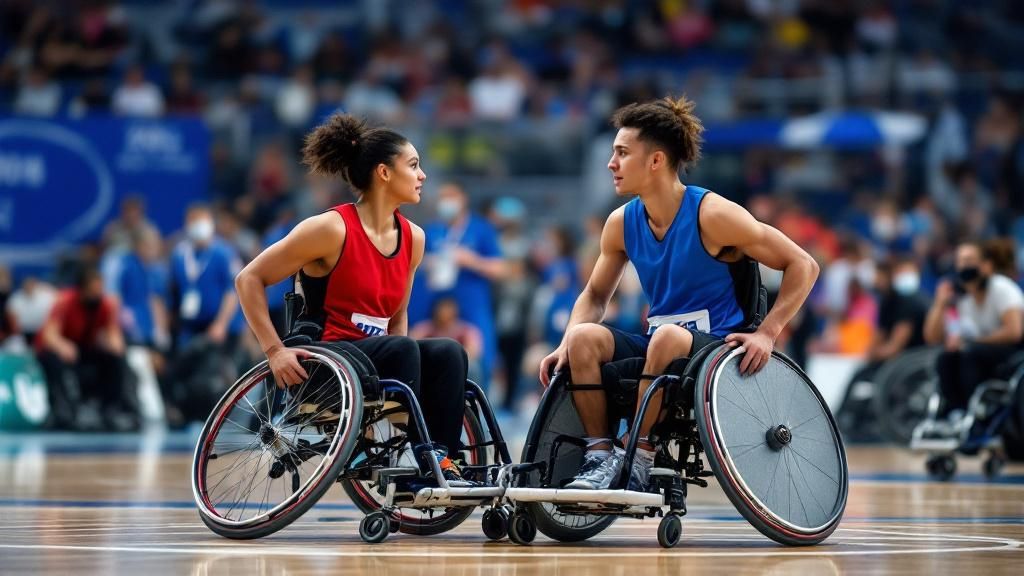
Wheelchair basketball athletes have captivated audiences internationally by showcasing remarkable skill and technical excellence at the renowned International Championship. These outstanding athletes have established that disability presents no barrier to professional-level performance, delivering captivating exhibitions that match any professional basketball tournament. From rapid ball control to remarkable slam dunk displays, participants have broken down misconceptions whilst playing at the top tier. This article investigates the defining performances, outstanding accomplishments, and uplifting tales that shaped this historic competition in adaptive sports.
Exceptional Performances Highlight Top-Tier Talent
The International Championship witnessed an extraordinary display of sporting excellence as wheelchair basketball competitors exhibited the highest calibre of skill and determination. Athletes executed complex defensive strategies with remarkable precision, whilst their offensive plays showcased impeccable court awareness and technical proficiency. The competitive intensity proved that these top-tier athletes operate at a standard equivalent to conventional professional basketball, captivating spectators with their explosive movements, strategic brilliance, and unwavering commitment to success across the competition.
Multiple impressive performances captured the imagination of both audiences and commentators, with competitors showcasing impressive exhibitions of accuracy in shooting and ball control. One particularly impressive match showcased a player performing a series of three-point shots with remarkable consistency, revealing the advanced technical skills honed through years of focused preparation and competitive play. These displays of individual skill enhanced the overall spectacle, highlighting the variety of skills that wheelchair basketball players demonstrate and their capability to excel under high pressure at championship level.
The tournament also featured outstanding team coordination, with well-orchestrated movements and fluid ball movement showcasing the advanced strategic methods utilised by rival countries. Coaches demonstrated remarkable strategic innovation, implementing intricate tactical setups and transitional plays that held viewer attention. The coordination among players, combined with lightning-fast wheelchair manoeuvrability, created a dynamic sporting experience that surpassed traditional basketball conventions and reset benchmarks concerning adaptive athletic performance.
Unprecedented achievements emerged throughout the championship, with several athletes exceeding previous statistical benchmarks in scoring, assists, and defensive contributions. These achievements underscore the continuous evolution of wheelchair basketball as competitors push physical and technical boundaries, setting fresh benchmarks for excellence. The quest for record-breaking performances motivated athletes to deliver consistently outstanding performances, enhancing the overall quality of competition and inspiring upcoming players of wheelchair basketball competitors worldwide.
The championship’s triumph ultimately showcased the devotion, strength, and outstanding skill of wheelchair basketball athletes who keep pushing forward with inclusive sports on the international stage. Their performances transcended competitive success, conveying powerful messages about human potential and ability. By displaying elite-level skills and consistent commitment, these outstanding athletes have cemented the status of wheelchair basketball as a top disability sport meriting international acknowledgement and recognition.
Skilled Execution and Tactical Play
The International Championship showcased wheelchair basketball athletes performing advanced attacking tactics with exceptional accuracy. Players demonstrated exceptional ball control, implementing intricate pick-and-roll formations and rapid-fire passing sequences that dissected opposing defences. Their positional awareness and positioning proved extraordinary, with competitors utilising sophisticated strategic plays to generate scoring opportunities. The level of technical proficiency shown rivalled elite able-bodied basketball, highlighting the sport’s tactical complexity and demanding skill requirements.
Mastery of Defence and Court Control
Protective efforts throughout the championship exemplified top-tier intensity and tactical expertise. Athletes implemented aggressive full-court pressing tactics whilst upholding disciplined positional awareness. Their skill in reading opponent movements, alongside quick wheelchair movement, formed strong defensive walls. Teams displayed complex zone defences and man-to-man coverage systems, efficiently containing opposing offences and forcing critical turnovers throughout intense periods.
Court dominance became a defining characteristic of elite teams. Athletes kept control through deliberate ball distribution and intelligent ball movement patterns. Their command of spacing, timing, and floor positioning displayed basketball intelligence matching professional competitions. Wheelchair mobility combined with tactical awareness enabled teams to control pace of play, dictate play flow, and assert tactical superiority throughout matches.
- High-pressure full-court pressing produced instant defensive intensity consistently.
- Swift wheelchair movement facilitated effective transition defence execution.
- Advanced zone defences neutralised rival offensive approaches effectively.
- Proactive positioning created crucial turnovers during crucial moments.
- Disciplined team defence maintained tactical shape across competitions.
Effects on the Game and Outlook Ahead
The International Championship has significantly enhanced wheelchair basketball’s standing on the worldwide sports landscape. Broadcast exposure has increased markedly, securing funding from multinational brands and expanded broadcast reach across numerous regions. This increased prominence has motivated young competitors to commit to wheelchair basketball, bolstering training schemes and grassroots projects worldwide. Sports authorities now acknowledge the business and cultural significance of disability sports, pledging substantial investments in sports facilities, coaching development, and competitor support for ongoing expansion.
Looking ahead, the sport encounters unprecedented opportunities for growth and development. Technical improvements in wheelchair design consistently boost performance capabilities, whilst rule modifications aim to increase competitive balance and viewer engagement. Worldwide sports organisations are establishing clearer pathways for athletes moving from community level to professional sport. Furthermore, greater Paralympic exposure promises broader societal embrace and commercial partnerships. These developments suggest wheelchair basketball will keep thriving, ultimately transforming perceptions of disability in sport and engaging audiences across the world.
